Saturday, October 24th was such a crazy day. It was the perfect weather for the annual
Boston Book Festival. The subway was kind of a pain with all of the delays but it made it in time for the Libba Bray Keynote. What I love about the Boston Book Festival is how all the panels take place at the Boston Public Library or at churches around the city near Copley Square.
Libba Bray's Keynote is the first YA Keynote the Boston Book Festival has ever hosted and boy was it packed. Bray's event was located in the Emmanuel Sanctuary. Thank you to Elizabeth from
Book YAbber and Marci from
Reading in the Tardis for saving me a seat! Libba is hilarious as always! Robin Brenner from the Brookline Public Library moderated the keynote. According to Libba, she is not organized when it comes to research. When researching for
The Diviners, she read many books about the early 1900's.
But how do you decide what to include in the book? Libba responded with "let me see, I'll have some cake and see what happens." But seriously, Libba will actually visit places to include in her books such as an asylum that will be a big part of Book 3 in
The Diviners series.
So what about the diversity of the cast in The Diviners series? How do you choose what character to bring out? The series is scheduled for 4 books with maybe a 5th book in the works. Libba mentioned about "there is nothing more powerful on Earth than story." She questions things like "who controls the narrative?," "how is the narrative and history shaped for us?" and "what is our responsibility?" Certain things are particular to the time period like Harlem and the Chinese Exclusion Act. Unions were important during the era as well. Diversity "represents the world we live in." If Libba was able to bring things back from the 1920's she would bring 1920's fashion, jazz and the radio when it was exciting and new.
Libba has always been a big horror fan. Horror is routed in emotional states with grief, death and sorrow. It's a metaphor of what humans do that are monstrous.
And what is the best and worst writing advice Libba received? According to Libba's favorite author, George Sanders, "take risks and tell the story you need to tell." Taking risks and listening are very important. I will leave it to that.
When Libba Bray was talking about drafts, I laughed when she talked about drafts.
Draft #13 - Help me baby Jesus.
Draft #14 - Jesus can't help you.
Libba explained how "the reader owns the book when it's in their hands. My work is done." In terms of audio book accents, she calls upon her theater background. It comes in handy for writing too. She claims, "I do hear all the voices in my head."
How does Libba develop characters? She likes to borrow characteristics from people she knows and dresses them in fabulous outfits.
One audience member was ecstatic that Libba added a bi-racial character to The Diviners series. Libba mentioned how an "healthy escape for us is fantasy. Books let you try on different identities. It nurtures the soul and fosters empathy and lets us explore."
Kirun Kapur moderated the
BBF Unbound: Why YA is for Everyone? panel with Rachel DeWoskin, Cindy Rodriguez and Carolyn Mackler. In 2010 YA purchases increased 30%. Nowadays, 50% of YA books are purchased by adults.
The panelists were asked what books they loved mattered to them when they were younger.
Cindy mentions how she has always been an avid reader and
The Outsiders by S.E. Hinton was her favorite book when she was younger. She can identify with Ponyboy even though Ponyboy is a male. Rachel said
The Bluest Eye by Toni Morrison was her favorite book. It changed the landscape of the imagination and understanding. Her views on interior life, life and politics changed. Carolyn often went to different books for different reasons. She gravitated toward Judy Blume but went to Lois Lowry for deep books.
What do adult overlook about young adults and children? Cindy mentioned how adults neglect everyday things that children and young adults go through. They hear swearing and experience romance. Life shouldn't be a glorified different reality. She tells adults not to be condescending and how adults shouldn't shelter and protect their children so much. Rachel mentioned how she tries to write novel with girls being nice to each other. The betrayals are often motives that are hard to coordinate and not because someone is being bad. Writing in different perspectives helps even if you don't include it in the novel. Carolyn talks about craft. She wrote five different novels before she finished the
Infinite in Between. This is helpful since she was able to capture the voices of all five high schoolers seamlessly and is able incorporate all five voices into one book. It is important to understand how the characters are affected by the same moments but see things in different perspectives.
Cindy mentioned if a character that a reader relates to dies, it sends a certain message to the reader. It is important to be selective and careful about the outcomes of characters throughout a novel. Rachel talked about coming back to what anchors you when thinking when going through dark times. Carolyn explained how it important for YA to understand what the author is going through. Dark times through life will reflect in the books. When the author is going through falling in love or having healthy friendships, happy moments shine in the novel When the author experience sickness, grief over a lost one or having any allergy scare, dark moments are seen in the novel. Cindy describes how she likes to write something different for a change of pace. Her first novel is dark and about despair but her second book is happy, fun and light.
Why write YA? Cindy explained about she can choose what she wants to read in YA instead of being assigned reading for school. Rachel said with YA you can say the truth. With Adult fiction, children in the novel are usually representing history of the past. With YA, there is no distance about the character. It happens right at the moment.
How do authors manage their days? Carolyn writes when the children are in school but social media is often a buzz kill and distraction She tries to create a white room when writing. Cindy lives for snow days and summers since she teaches and has a child.
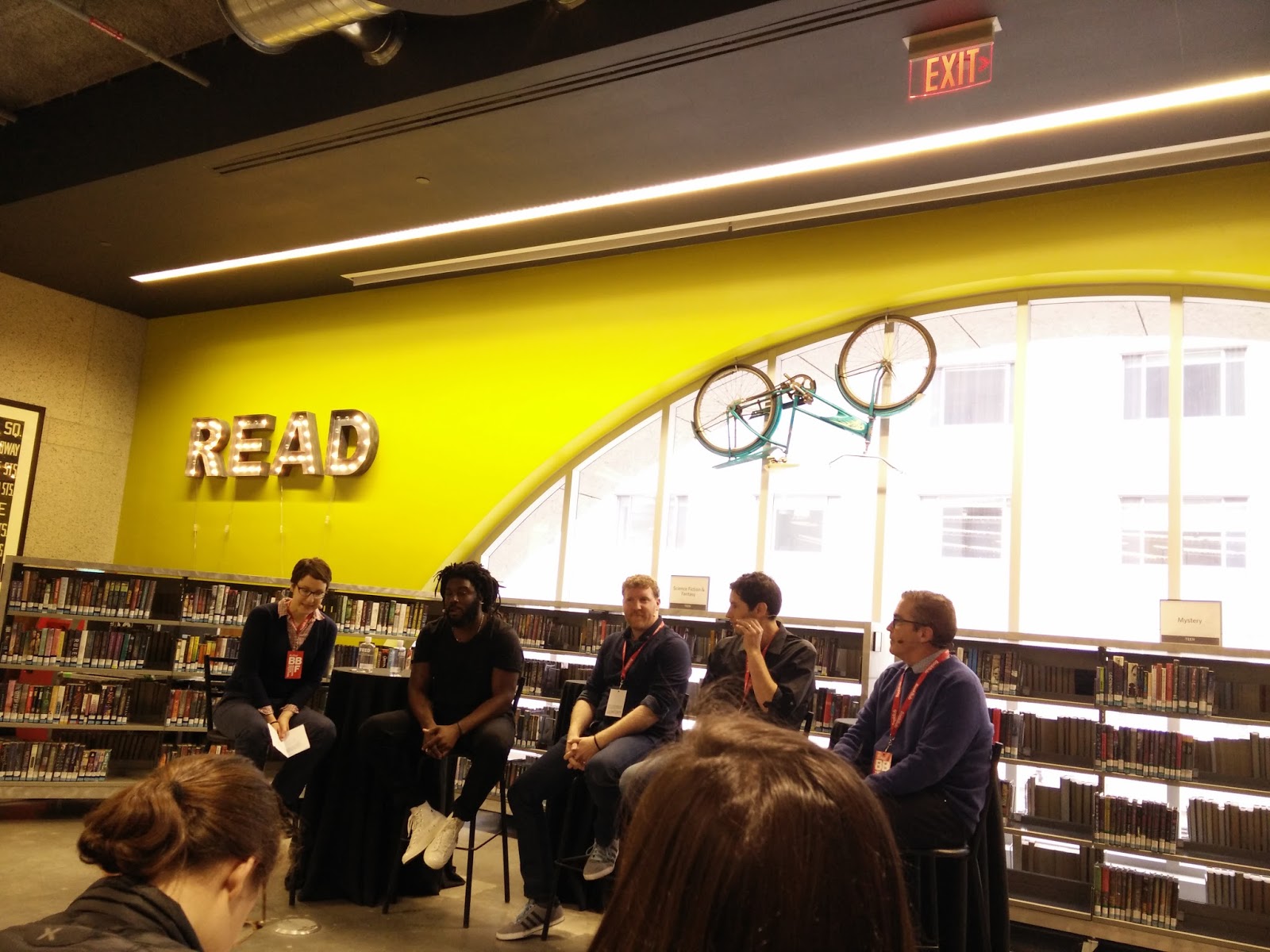
My last panel took place at the Teen Center at the Boston Public Library. Not only is the Boston Public Library in Copley Square amazingly beautiful but it's freaking HUGE! I feel like I am walking into Hogwarts!
The YA: Boys to Men panel was moderated by Amy Pattee and authors present included Jason Reynolds, Brendan Kiely, Matt de la Peña and Andrew Smith. This panel was definitely my favorite out of the three at the Boston Book Festival. There was a lot of information I can use to help encourage my students to read books. It is interesting about how they talked about males being the minority when it comes to YA readers and YA authors. I was also interested about what authors had to say about profiling and stereotyping targeted against certain groups.
When Matt first sold his first book and his literary agent told him it sold as YA, Matt admitted to Googling YA since he didn't know what it was. He writes books and strives for literature. He tells people to avoid repeating yourself and to try something new. Matt also mentions how socioeconomic and cultural differences shape who a person is. In certain cultures, males have certain expectations they have to live up to and if they don't, they are look down upon.
Jason talked about when he writes, he doesn't push his agenda; he writes life stories. He is a male and a writer but he tells the audience that he is not a male writer. There's a difference. A writer is a writer. It shouldn't matter if the writer is male or not. Jason writes for others and not for a particular gender nor demographic. He writes characters as human beings. Someone once asked him how he writes females well in his novels. Jason responded because it is part of his profession, he just writes.
Jason actually mentioned that at a juvenile hall, most kids wanted to read romances. They wanted to read books by Gayle Forman, Jenny Han, Cassandra Clare and by Lauren Oliver. They didn't read books by Jason Reynolds and Walter Dean Meyers. You cannot profile people about what they read. When boys and young men are asked if they are okay and when they say they are fine, they are usually not fine. They experience the sadness or the pain but society tells them that they must suck it up.
Andrew believes a lot of males have this internal struggle and that they are boxed in because of the Y chromosome. Society tells males to be masculine and strong. They are high expectations to live up to. Andrew writes what he knows. He doesn't sugarcoat anything. Andrew mentions how male authors are a minority in YA whether it be in publishing industry or as an author. He also gives advice to students about how falling in love will not fill out all the empty holes you have. Don't get caught up in relationships.
Brendan mentions how we should diversify all books to reach all types of readers. Someone is not born a reader; a reader is made. Authors need to create the work in order for people to latch on to and to read. They need to create the springboard.
How do you promote literacy to males, especially if the males are very masculine?
Andrew said to break down gender barriers for books. Just talk about books. See what kind of books they will be interested in. Matt mentioned that you need to read to them and not just any book. You need to read books that they want to read. Brendan encouraged showing movie clips of film adaptations. Relate the film to the book counterpart. Comparisons will help get the reader interested. Jason gave great advice about how to get males to read. Don't be tied down to stories. He said to give them all types of things to read. You can use rap lyrics and tell males that it's poetry. Get them interested to lyrics because when you get them hooked, they will want to read more. You want to open it up to what it means to read.
A librarian asked how do you have diverse books be available to readers especially when others on a committee claim diverse books don't get checked out often from the library? Pitch two books and see what the child chooses. Educating readers about what types of books are out there also helps. Once a reader finds an author on genre that speaks to them, they will be hungry for more.
THANK YOU to all the authors, publishers, Boston Book Festival organizers and volunteers for making this event possible!